
Cosmological Coherence: From Solar Field to Cellular Intelligence to Civilizational Vitality
By Dr. Marcus Robinson | DCH IHP QBH | Adaptive Terrain Institute |June 2026
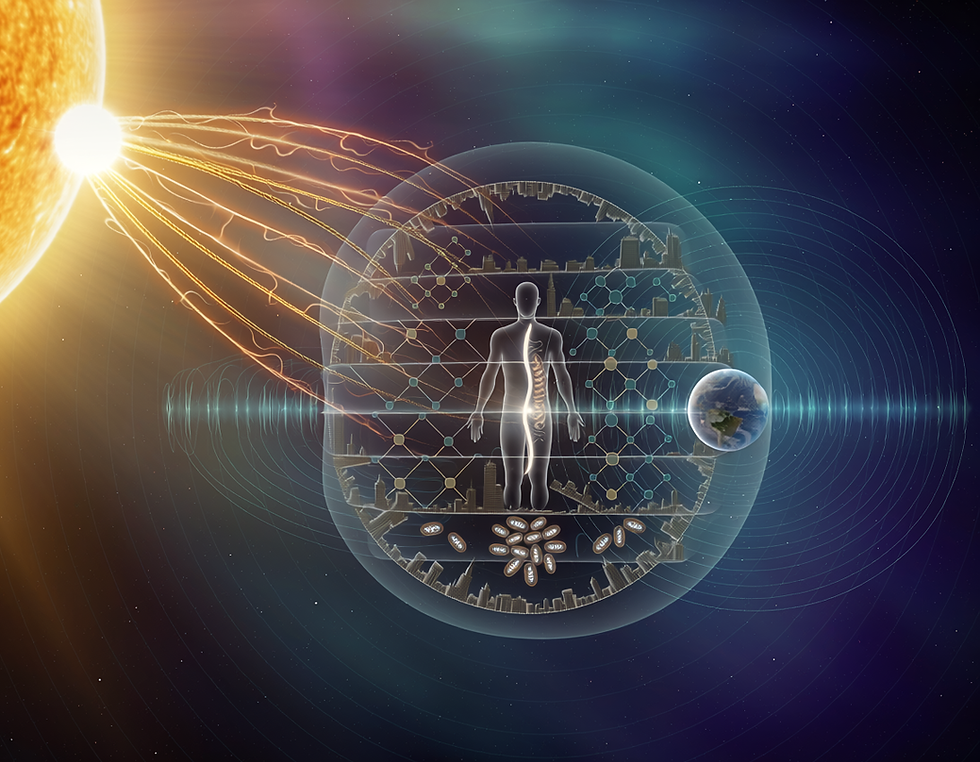
Preface: Standing Between the Instrument and the Infinite
I write this paper from an unusual vantage point — one that is simultaneously personal, scientific, and mythic. I do not apologize for any of these registers. I require all three.
My inquiry did not begin with a hypothesis. It began with a sensation.
During periods of heightened solar activity, after years of deliberate mitochondrial tuning and somatic attunement, I began to notice something that the standard scientific vocabulary was not built to name. Colors carried more information. Patterns revealed themselves at greater range and depth. My internal coherence — gut, heart, brain — felt synchronized in a way that was not mystical in origin, but biological in mechanism. What I was experiencing was not imagination. It was resolution. The instrument had been tuned, and it was picking up signal.
I traced these experiences back through physiology — through cryptochrome and voltage-gated calcium channels, through transmembrane potential and electron transport, through the autonomic nervous system's response to geomagnetic fluctuation — and found that the science was already there. Not fringe science. Biophysics. The literature existed. What was missing was the integrative frame that could hold it all together without losing the lived experience that had sent me looking in the first place.
This paper is that frame.
But it is more than a synthesis of existing science. It is an extension — unapologetic and deliberate — into territory the existing literature has not yet entered. The scalar leap this paper proposes is this: the same dynamics that govern mitochondrial coherence at the cellular level govern coherence at every level of organized complexity — individual, institutional, civic, civilizational. This is not metaphor. It is the fractal logic of terrain.
I stand in a particular lineage that informs this work: initiatory formation in Huna through Uncle George Naope at Papa Honua; clinical hypnosis and ontological linguistics rooted in the Erhard tradition; the esoteric canon of Manly P. Hall, Inayat Khan, and Muktananda; and the Black Church tradition of my formation, which understood long before Western science that the human being is a resonant instrument embedded in a field far larger than itself. I do not separate these streams from the science. They are part of the epistemological terrain from which this paper emerges.
I stand between the instrument and the infinite.
Between the mitochondrion and the sun.
Between the measurable and the meaningful.
Between the cellular and the civilizational.
This is the place from which I write.
Part I: The Cosmic Field — Solar Dynamics as Biological Habitat
1.1 The Sun as Conductor of Biological Tempo
The Sun as Conductor of Biological Tempo
Most people think of solar storms as events that affect satellites, power grids, and astronauts operating beyond Earth's protective magnetosphere. The effects feel remote — technical, instrumental, belonging to a world of engineers and astrophysicists.
But for a growing and increasingly documented population of human beings, the effects feel far more personal.
Sleepless nights before a storm arrives. Restlessness without identifiable cause. A strange, heightened alertness. An uncanny sense that something is shifting in the field before any instrument has registered it. These are not psychological artifacts. They are biological signals. And the science of why this is so is older and more robust than popular awareness would suggest.
Every day, the Sun projects a continuous stream of charged particles toward Earth — the solar wind. Under ordinary conditions this stream is relatively steady, its effects on Earth's magnetosphere largely invisible to biological systems tuned for more immediate threats. But during periods of heightened solar activity — coronal mass ejections, solar flares, geomagnetic storms — this stream intensifies dramatically. The charged plasma interacts with Earth's magnetic field, inducing disturbances that propagate through the electromagnetic environment in which all terrestrial life is embedded.
These events are called geomagnetic disturbances, and they are measurable across multiple dimensions of the electromagnetic spectrum:
• Shifts in Earth's static magnetic field intensity and direction
• Alterations in Schumann resonance amplitudes — the extremely low frequency electromagnetic resonances that exist in the cavity between Earth's surface and ionosphere
• Changes in solar wind proton density
• Ultra-low frequency magnetic oscillations that penetrate biological tissue
We do not see these changes. We do not smell or taste them. But our biology — as this paper will demonstrate — is not blind to them.
1.2 Earth's Electromagnetic Environment as Biological Habitat
The conventional framing of environment as biological habitat focuses on temperature, humidity, atmospheric composition, and nutrition. These are the variables that evolutionary biology has taught us to track. But this framing is incomplete.
Life on Earth evolved inside an electromagnetic environment that has been active, variable, and influential since the earliest unicellular organisms. The Schumann resonances — first calculated by physicist Winfried Schumann in 1952 and subsequently measured and confirmed — oscillate at frequencies (7.83 Hz fundamental, with harmonics at 14.3, 20.8, 27.3, and 33.8 Hz) that overlap with the dominant EEG rhythms of the human brain. This overlap is not coincidental. It is the signature of co-evolution.
Earth's geomagnetic field has shaped the biology of every organism that has lived within it. Magnetosensitive proteins are present across taxa from bacteria to birds to humans. The magnetic sense is not exotic. It is ancestral. What varies is the degree to which different organisms — and different individuals within species — have retained or developed the capacity to transduce geomagnetic information into functional biological response.
The human organism is not outside this field. It is inside it. The electromagnetic environment is not a backdrop to human biology. It is part of the habitat in which human biology operates, adapts, and — in coherent systems — thrives.
1.3 The Coupling Chain
When a geomagnetic disturbance occurs, the causal chain between the solar event and the human biological response is not mysterious. It is mechanistic, traceable, and increasingly documented in peer-reviewed literature:
Solar Activity → Geomagnetic Disturbance → Electromagnetic Field Fluctuation → Magnetosensitive Biological Systems → Neuroendocrine Response → Autonomic Nervous System Shift → Subjective and Measurable Experience
Each link in this chain is scientifically grounded. The following sections trace the biology of each link — beginning at the cellular level with the organelle that sits at the electromechanical interface between the organism and its electromagnetic environment.
Part II: The Cellular Receiver — Mitochondria as Electromechanical Interface
2.1 Beyond the Powerhouse Metaphor
The standard introduction to mitochondria describes them as the powerhouses of the cell — the organelles responsible for producing adenosine triphosphate (ATP), the energy currency that drives cellular function. This description is accurate as far as it goes. It does not go nearly far enough.
Mitochondria are electromechanical sensors. They are the primary site at which the body's electromagnetic environment is transduced into biological signal. Understanding this is the foundation of everything that follows.
The mitochondrial inner membrane maintains a transmembrane potential (TMP) of approximately 150–180 millivolts — the strongest sustained electrical gradient in the biological body. This is not a passive feature. It is an active, dynamically regulated system that responds in real time to changes in the internal and external electromagnetic environment. The membrane potential drives ATP synthesis through the enzyme ATP synthase, regulates calcium flux, controls the production of reactive oxygen species (ROS) as signaling molecules, and governs the decision between cellular growth and cellular survival.
Mitochondria are not static structures. They are dynamic networks — fusing, dividing, migrating within cells in response to energetic demand and environmental signal. They maintain their own DNA — a relic of their origin as independent prokaryotic organisms that entered into endosymbiotic relationship with eukaryotic cells approximately 1.5 billion years ago. That ancient lineage matters. These are organisms with a deep evolutionary history of environmental sensitivity. Their descendants, now resident in nearly every cell in the human body, retain that sensitivity.
2.2 Magnetosensitive Proteins and Electromagnetic Transduction
The mechanisms by which biological systems transduce electromagnetic information into biochemical signal are multiple and increasingly well understood.
Cryptochrome is a flavoprotein found across taxa — in plants, insects, birds, and mammals, including humans. It is sensitive to both light and magnetic fields through a mechanism involving radical pair chemistry: the quantum mechanical behavior of paired electrons whose spin states are influenced by external magnetic fields. In humans, cryptochrome is expressed in the retina, the brain, and peripheral tissues, where it plays a role in circadian rhythm regulation. Its magnetic sensitivity means that fluctuations in Earth's geomagnetic field can influence cryptochrome function — and through it, the circadian timing system that regulates virtually every physiological rhythm in the body.
Voltage-gated calcium channels respond to electromagnetic field variation across a wide frequency range. Calcium is a universal second messenger in biological signaling — its flux into and out of cells and cellular compartments regulates everything from neuronal firing to muscle contraction to gene expression. When external electromagnetic fields shift, voltage-gated calcium channels can respond, altering intracellular calcium dynamics and the downstream signaling cascades that depend on them.
Cytochrome c oxidase (COX), the terminal enzyme in the mitochondrial electron transport chain, is sensitive to photonic input across a range of wavelengths. Photobiomodulation research demonstrates that light exposure modulates COX activity, influences nitric oxide dissociation, and alters ATP production and mitochondrial dynamics. The same enzyme complex that responds to photons is positioned at the heart of the organelle that regulates cellular energy production — establishing a direct pathway from electromagnetic environment to metabolic output.
2.3 The Melatonin Interface
Melatonin is the most widely recognized interface between the body's electromagnetic environment and its neuroendocrine system. Commonly described as a sleep hormone, this framing significantly underrepresents melatonin's biological role.
Melatonin is produced in mitochondria. It acts as a master regulator of circadian timing, a potent antioxidant operating within the mitochondrial membrane itself, a modulator of mitochondrial membrane potential, and a primary signal of autonomic balance. Its production is governed by cryptochrome-mediated circadian timing and by the pineal gland's sensitivity to light — and, as documented in HeartMath Institute research, to geomagnetic field fluctuation.
During geomagnetic disturbances, documented effects on melatonin rhythms include:
• Alterations in the timing of the serotonin-to-melatonin conversion
• Shifts in melatonin's release window
• Changes in the amplitude of the nocturnal melatonin peak
• Disruption of the circadian entrainment that melatonin anchors
These alterations produce the constellation of experiences that geomagnetically sensitive individuals report: difficulty initiating sleep, restlessness, fragmented sleep, heightened alertness at night, and — notably — anticipatory wakefulness in the 24–72 hours before a major storm event, before any instrument has registered the disturbance.
2.4 Mitochondrial Optimization and Sensitivity Amplification
Here the framework introduces its most consequential insight: the relationship between mitochondrial optimization and electromagnetic sensitivity is not inverse but direct.
The conventional assumption holds that sensitivity to environmental perturbation is a sign of fragility — that a robust system would be less affected by external fluctuation, not more. This assumption is incorrect in the context of electromagnetic sensitivity and mitochondrial coherence.
A system with optimized mitochondrial function — characterized by high and stable TMP, smooth and efficient electron flow through the transport chain, low oxidative noise, robust redox balance, and well-anchored circadian rhythm — is a high-coherence, low-noise system. And high-coherence, low-noise systems are more sensitive to subtle signal, not less. A finely tuned instrument picks up frequencies that a poorly maintained one cannot register.
The individuals who feel geomagnetic disturbances most clearly are not fragile. They are coherent. Their systems are:
• Well-nourished at the micronutrient level that mitochondrial function requires
• Metabolically flexible — capable of utilizing multiple fuel sources efficiently
• Redox-balanced — maintaining the oxidative state that supports clear signaling
• Circadian-aligned — entrained to light, temperature, and timing cues that synchronize biological rhythms
• Low in background electromagnetic noise from inflammatory, metabolic, or psychological sources
This is not a flaw. It is a form of biological intelligence.
Part III: The Tuned Organism — Bioenergetic Intuition as Bandwidth Expansion
3.1 Reframing Sensitivity as Coherence
The language of sensitivity carries an unfortunate connotation in contemporary culture — it implies vulnerability, reactivity, a deficit of robustness. When individuals report feeling solar storms in their bodies, the default cultural response is skepticism at best and pathologizing at worst.
Adaptive Terrain Theory proposes a different frame entirely.
What is being described by geomagnetically sensitive individuals is not pathology. It is the natural perceptual consequence of a well-maintained biological system operating in its actual electromagnetic habitat. The anomaly is not the sensitivity. The anomaly is the cultural norm of treating the electromagnetic environment as irrelevant to biology — a norm that emerged from a mechanistic, chemistry-first model of living systems that is now demonstrably incomplete.
This paper proposes the term bioenergetic intuition to name the phenomenon: a heightened capacity to detect and integrate subtle sensory information — electromagnetic, photonic, cymatic, kinesthetic — that typically operates below conscious thresholds in less coherent biological systems.
Bioenergetic intuition is not extra-sensory perception. It is not a claim about supernatural capacity. It is a claim about the latent bandwidth of sensory systems that are operating at higher energetic tempo — and about the natural perceptual expansion that occurs when that tempo is elevated, whether through mitochondrial optimization, environmental amplification during geomagnetic events, or both simultaneously.
3.2 The Tempo Model of Perception
The central insight of this section is deceptively simple:
Perception is tempo-dependent.
Biological tempo — the rate at which cellular processes operate, the speed and fidelity of intracellular signaling, the coherence of communication across the gut-heart-brain axis — is not fixed. It is dynamically regulated by mitochondrial energetics, by the electromagnetic environment, and by the choices of the organism regarding nutrition, timing, movement, and stress.
When biological tempo increases — through elevated TMP, smoother electron flow, reduced oxidative noise, and the amplification provided by geomagnetic field fluctuation — the perceptual field expands. Not because new sensory organs emerge, but because existing sensory systems are operating with greater fidelity, faster processing, and reduced threshold for conscious detection of subtle input.
The world does not become louder. The listener becomes more attuned.
This is the mechanism underlying the phenomenon that practitioners in contemplative, somatic, and initiatory traditions have described across cultures and millennia: the experience of heightened perception during specific environmental conditions, during particular states of biological and energetic preparation, and at the intersection of both. Adaptive Terrain Theory does not mystify this phenomenon. It mechanizes it — traces it to the biophysics of mitochondrial function and electromagnetic transduction — and in doing so, makes it available as a variable that can be deliberately cultivated.
3.3 The Gut-Heart-Brain Axis as Distributed Processor
Perception in this framework is not a function of the brain alone. It is distributed across the organism's full sensing architecture.
The enteric nervous system — comprising approximately 500 million neurons embedded in the gastrointestinal tract — operates as a largely autonomous processor, sensing chemical and electromagnetic conditions in the gut environment and transmitting signals both to and from the central nervous system. The gut microbiome, whose metabolic output directly influences neurotransmitter production and immune signaling, functions as an additional sensing layer with its own sensitivity to electromagnetic conditions.
The cardiac intrinsic nervous system — the approximately 40,000 neurons embedded in the heart — processes electromagnetic and hormonal information and generates a field measurable several feet from the body. HeartMath Institute research has documented the heart's sensitivity to geomagnetic conditions and its role as a mediating organ between environmental electromagnetic fluctuation and central nervous system response.
The brain integrates the signals arising from these distributed processors through thalamocortical networks whose coherence is itself sensitive to both internal mitochondrial state and external electromagnetic conditions.
When these three distributed processors are operating in coherent alignment — when gut, heart, and brain are synchronized — the organism's total sensing bandwidth is maximized. This is the state that bioenergetic intuition describes. And it is the state that geomagnetic amplification, in a well-tuned organism, reliably promotes.
Part IV: When the Forge Dims — Terrain Degradation and the Cost of Incoherence
4.1 The Slow Arc of Dimming
Hidden inside every neuron — inside every cell — is what this paper has called the forge: the mitochondrial network whose energetic output and electromagnetic sensitivity determine the quality of biological function at every scale. When the forge burns brightly — when TMP is high, electron flow is smooth, redox balance is maintained, and the organism is aligned with its electromagnetic habitat — the system operates with coherence, adaptability, and perceptual richness.
When the forge dims, the consequences are not immediate or dramatic. They are slow. They accumulate. They express across years and decades as the gradual erosion of what Adaptive Terrain Theory calls terrain resilience — the capacity of a living system to adapt, repair, and evolve in response to challenge.
The most documented expression of this dimming at the neurological level is cognitive decline and dementia. Current research is producing a convergent finding that represents a paradigm shift in how we understand these conditions: mitochondrial dysfunction appears years, sometimes decades, before any detectable cognitive symptom. The forge dims long before memory begins to fail.
4.2 Dementia as Terrain Disorder
The conventional framing of dementia — organized around amyloid plaques, tau tangles, and the downstream debris of neuronal collapse — has produced limited therapeutic progress precisely because it focuses on the wreckage rather than the fire that produced it. A terrain-based analysis directs attention upstream.
When mitochondrial function degrades, the causal cascade moves through several interdependent channels:
Bioenergetic decline: The brain consumes approximately 20% of the body's total energy production while comprising only 2% of its mass. It is the most energetically demanding organ in the body. When mitochondrial ATP output falls, the first casualties are the highest-complexity cognitive functions: attention, working memory, processing speed, emotional regulation.
Redox dysregulation: As mitochondrial efficiency falls, the balance between ROS production as signaling and ROS production as damage tips toward the latter. Chronic oxidative stress activates microglia — the brain's resident immune cells — producing the neuroinflammatory state that slowly erodes neural network integrity. Recent research from Orr (2025) specifically identifies astrocyte-derived mitochondrial ROS as a direct trigger of this neuroinflammatory cascade.
Impaired mitophagy: The body's capacity to identify and remove damaged mitochondria — mitophagy — depends on states of energetic surplus and parasympathetic dominance. Without adequate deep sleep, fasting windows, and recovery from sympathetic activation, the cellular housekeeping system falls behind. Damaged mitochondria accumulate. The forge becomes cluttered with its own debris.
Circadian disruption: The circadian timing system that governs virtually every biological rhythm — including mitochondrial biogenesis, mitophagy, and the melatonin arc that protects neuronal DNA during sleep — is among the earliest systems to show disruption in dementia. This reflects the upstream role of circadian coherence in maintaining the biological conditions that mitochondrial health requires.
Metabolic rigidity: The brain's capacity to utilize multiple fuel sources — glucose, ketones, lactate — is a function of mitochondrial health. As mitochondrial function degrades, metabolic flexibility narrows. Researchers increasingly describe this narrowing as "type 3 diabetes" — in which neurons are progressively deprived of the energetic substrates they require.
Causality has now been established. Research from Marsicano and colleagues at Inserm (2025), using precision tools to directly modulate mitochondrial output in living brains, produced reversal of memory loss in animal models — establishing that mitochondrial dysfunction is not merely correlated with cognitive decline but is causally upstream of it.
4.3 Terrain Stewardship as Cognitive Resilience Protocol
If dementia is a terrain disorder — the long-arc expression of a forge that has been dimming for years — then the path to cognitive resilience is a ritual architecture: a deliberate, integrated set of practices that continuously signal safety, coherence, and vitality to the mitochondrial network.
Adaptive Terrain Theory proposes the following framework for terrain stewardship in the context of cognitive resilience:
• Light as circadian anchor: Morning full-spectrum sunlight entrains the circadian timing system that governs mitochondrial biogenesis and melatonin production. Evening darkness protects the melatonin arc that enables neuronal repair during sleep.
• Breath as autonomic signal: Slow, coherent breathing — particularly extended exhalation — shifts autonomic tone toward parasympathetic dominance, reducing the cortisol and sympathetic signaling that forces mitochondria into survival mode.
• Movement as mitochondrial stimulus: Physical movement is the primary signal that stimulates mitochondrial biogenesis. Not as punishment or performance, but as biological communication: we are alive, we are needed, produce more capacity.
• Rhythmic fasting and feeding: Windows of caloric restriction trigger autophagy and mitophagy — the cellular housekeeping processes that remove damaged mitochondria. Windows of nutritional abundance signal the metabolic conditions for growth and biogenesis.
• Sleep as the great housekeeper: Deep, uninterrupted sleep activates the glymphatic system — the brain's waste-clearance network — and enables the mitophagy that removes accumulated cellular damage.
• Redox and detoxification stewardship: Targeted nutritional support for the mitochondrial electron transport chain — including polyphenols, full-spectrum micronutrients, MCTs, and cruciferous compounds — maintains the redox balance that separates coherent signaling from oxidative noise.
• Narrative coherence as biological signal: The stories we tell about aging, memory, possibility, and identity shape autonomic tone. Autonomic tone shapes mitochondrial behavior. Mitochondrial behavior shapes cognition. The narrative environment is part of the terrain.
Part V: The Fractal Extension — Coherence Across Scales
5.1 The Unapologetic Claim
This is the section that moves beyond the existing literature. Not away from it — the scientific grounding of the preceding sections remains the foundation. But beyond it, into terrain that Adaptive Terrain Theory was built to occupy.
The claim is this:
The dynamics of coherence and incoherence that govern mitochondrial function at the cellular level are fractal — they operate by the same logic at every scale of organized complexity, from the organism to the institution to the civilization.
This is not metaphor. It is the application of a systems principle that has been established at the biological scale to the organizational and civilizational scales where it has not yet been formally applied — but where its diagnostic utility is immediately visible to anyone trained to see it.
5.2 The Shared Architecture of Coherence
At the cellular level, coherence requires:
• A high-energy, well-maintained core system (the mitochondrial network)
• Responsive, low-noise signaling channels between components
• Effective housekeeping — removal of damaged elements before they compromise the whole
• Circadian rhythm — temporal coherence, the right processes happening at the right times
• Metabolic flexibility — the capacity to adapt to changing energetic conditions
• Protection from chronic sympathetic overdrive that forces survival mode at the expense of repair and growth
At the institutional level, the structural analogs are direct:
• A high-capacity, experienced core operator layer (the organizational equivalent of the mitochondrial network)
• Clear, low-noise communication channels within and across organizational levels
• Effective institutional housekeeping — accountability mechanisms that identify and remove dysfunction before it propagates
• Temporal coherence — strategic rhythm, planning cycles, the institutional equivalent of circadian alignment
• Adaptive capacity — the organizational flexibility to respond to changing conditions without structural collapse
• Protection from chronic crisis-mode operation that forces short-term survival behavior at the expense of long-term institutional health
The diagnostic framework transfers precisely. And — critically — the failure modes transfer with equal precision.
5.3 Institutional Cavitation
The term cavitation — borrowed from fluid dynamics — describes the formation of vapor cavities in a liquid moving through a region of low pressure. The cavities collapse violently when they encounter higher pressure, producing destructive shock waves. Cavitation destroys turbine blades, pump impellers, and ship propellers — not through dramatic single events but through the cumulative damage of repeated microscopic collapses.
Adaptive Terrain Theory applies this term to the institutional equivalent: the systematic hollowing of an organization's experienced operator layer — its mitochondrial network — in ways that appear manageable in the short term but produce cumulative structural damage that becomes catastrophic when the system encounters a high-pressure event.
When an institution replaces its experienced operator layer with personnel selected primarily for ideological conformity rather than functional competence, it is not merely losing expertise. It is degrading its coherence infrastructure. The informal knowledge networks that enable adaptive response. The experienced judgment that distinguishes signal from noise. The institutional memory that holds the lessons of past high-pressure events. These are not soft assets. They are the functional equivalent of the mitochondrial network's TMP — the energetic potential that determines whether the system can mount a coherent response when challenged.
The diagnostic markers of institutional cavitation mirror those of mitochondrial degradation with uncomfortable precision: reduced adaptive capacity, impaired housekeeping (accountability), disrupted temporal coherence (strategic rhythm), narrowing of the institutional metabolic flexibility that enables response to novel conditions, and the chronic sympathetic-equivalent that forces short-term survival behavior at the expense of long-term institutional repair and growth.
5.4 The Civilizational Scale
The scalar extension does not stop at the institutional level. Adaptive Terrain Theory proposes that the same diagnostic framework applies at the civilizational scale — and that the most consequential civilizational challenges of the current moment can be understood as expressions of coherence failure at multiple simultaneous scales.
A civilization that systematically depletes its mitochondrial equivalents — its experienced knowledge-holders, its coherence infrastructure, its capacity for adaptive response to novel conditions, its narrative coherence regarding who it is and what it is for — is a civilization whose forge is dimming. The decline will not appear dramatic in its early stages. It will appear as a series of systems failures, institutional brittleness, and response deficits that seem unrelated until the underlying terrain degradation that produced them is visible.
The civilizational rites of coherence restoration mirror the cellular and institutional frameworks with the same structural logic: restoration of the experienced operator layer; reconstruction of clear, low-noise signaling channels across civic and institutional structures; effective housekeeping through accountability mechanisms; recovery of temporal coherence in civic rhythm; cultivation of the adaptive capacity — the civilizational metabolic flexibility — that enables response to conditions that have no historical precedent.
This is not prediction. It is diagnosis. And diagnosis, in the ATT framework, is always the precondition of restoration.
Conclusion: The Coherent Organism at Every Scale
This paper has traced a single continuous argument from the surface of the sun to the interior of the cell to the structure of civilizational vitality.
The argument is this: coherence is the fundamental condition of vitality at every scale of organized complexity. It is not a nice-to-have. It is the operating condition without which adaptive capacity, perceptual richness, and resilient response to challenge become impossible. And the mechanisms of coherence — and of its degradation — are the same at the cellular, organismal, institutional, and civilizational levels, operating by the same fractal logic across orders of magnitude of complexity.
The solar field is not a backdrop to human biology. It is part of the habitat in which human biology evolved and in which it continues to operate. Mitochondria are not mere ATP factories. They are the electromechanical interface between the organism and its electromagnetic environment — ancient sensors whose sensitivity increases, not decreases, with coherent optimization. Bioenergetic intuition is not supernatural. It is the natural perceptual consequence of a well-tuned biological system operating in its actual habitat at elevated tempo. Dementia is not inevitable neurological destiny. It is the long arc of terrain degradation that can be identified, interrupted, and in many cases reversed through deliberate terrain stewardship. And institutional and civilizational decline are not mysterious historical forces. They are coherence failures that can be diagnosed with the same framework that identifies mitochondrial degradation — and addressed with the same fractal logic that governs terrain restoration at every scale.
We are not separate from cosmic rhythms.
We are participants in them.
The organism that knows this — and acts on it — is the coherent organism.
The coherent organism is the New Human the next chapter of civilization requires.
References
Al-Khalili, J., & McFadden, J. (2014). Life on the Edge: The Coming of Age of Quantum Biology. Crown Publishers.
Bredesen, D. (2017). The End of Alzheimer's. Avery.
Cardoso, F. dos S., Barrett, D. W., Wade, Z., Gomes da Silva, S., & Gonzalez-Lima, F. (2022). Photobiomodulation of cytochrome c oxidase by chronic transcranial laser in young and aged brains. Frontiers in Neuroscience, 16. https://doi.org/10.3389/fnins.2022.818005
da Silva Neto Trajano, L. A., et al. (2024). Does photobiomodulation alter mitochondrial dynamics? Photochemistry and Photobiology. https://doi.org/10.1111/php.13963
Hsieh, H.-C., Tseng, W.-W., & Wei, A.-C. (n.d.). Mathematical model of photobiomodulation on cytochrome c oxidase. IEEE. ResearchGate.
Lipton, B. (2005). The Biology of Belief. Hay House.
Marsicano, G., et al. (2025). Causal link between mitochondrial dysfunction and dementia symptoms. Inserm & Universite de Moncton.
McCraty, R., Atkinson, M., Tomasino, D., & Bradley, R. T. (2009). The coherent heart: Heart-brain interactions, psychophysiological coherence, and the emergence of system-wide order. Integral Review, 5(2), 10–115.
Orr, A., & Orr, A. (2025). Free radicals from astrocyte mitochondria fuel dementia. Nature Metabolism.
Panda, S. (2020). The Circadian Code. Rodale Books.
Smith, R. A. J., et al. (2024). MitoQ prevents memory loss and early Alzheimer's pathology. PMC.
Wallace, D. C. (2018). Mitochondrial genetic medicine. Nature Genetics.
About the Author:
Marcus Robinson is the founder of the Adaptive Terrain Institute and a leading voice in the emerging field of multisystem human ecology. His work blends scientific rigor, ancestral intelligence, and systems‑level analysis to map how individuals and civilizations adapt under stress. A longtime strategist, educator, and movement architect, Marcus helps leaders navigate complexity by revealing the hidden terrains—biological, psychological, relational, and civilizational—that shape human behavior and collective futures. His writing invites readers into a deeper coherence, where personal transformation and societal evolution become part of the same living system.


Comments